


The 2008 film The Oxford Murders, based on the novel by Spanish author Guillermo Martínez, presents itself as an intellectual thriller. In it, Martin, an American math student, and the eminent Professor Arthur Seldom attempt to decipher a series of crimes linked by mathematical symbols and philosophical paradoxes.1 However, beneath the surface of this academic puzzle lies a devastating legacy of intellectual corruption and failures in medical institutions. The film’s portrayal of sleuthing is both problematic and intriguing, while its brief but powerful representation of lobotomy serves as a symbol for the pervasive power of human hubris
The Plot Summary
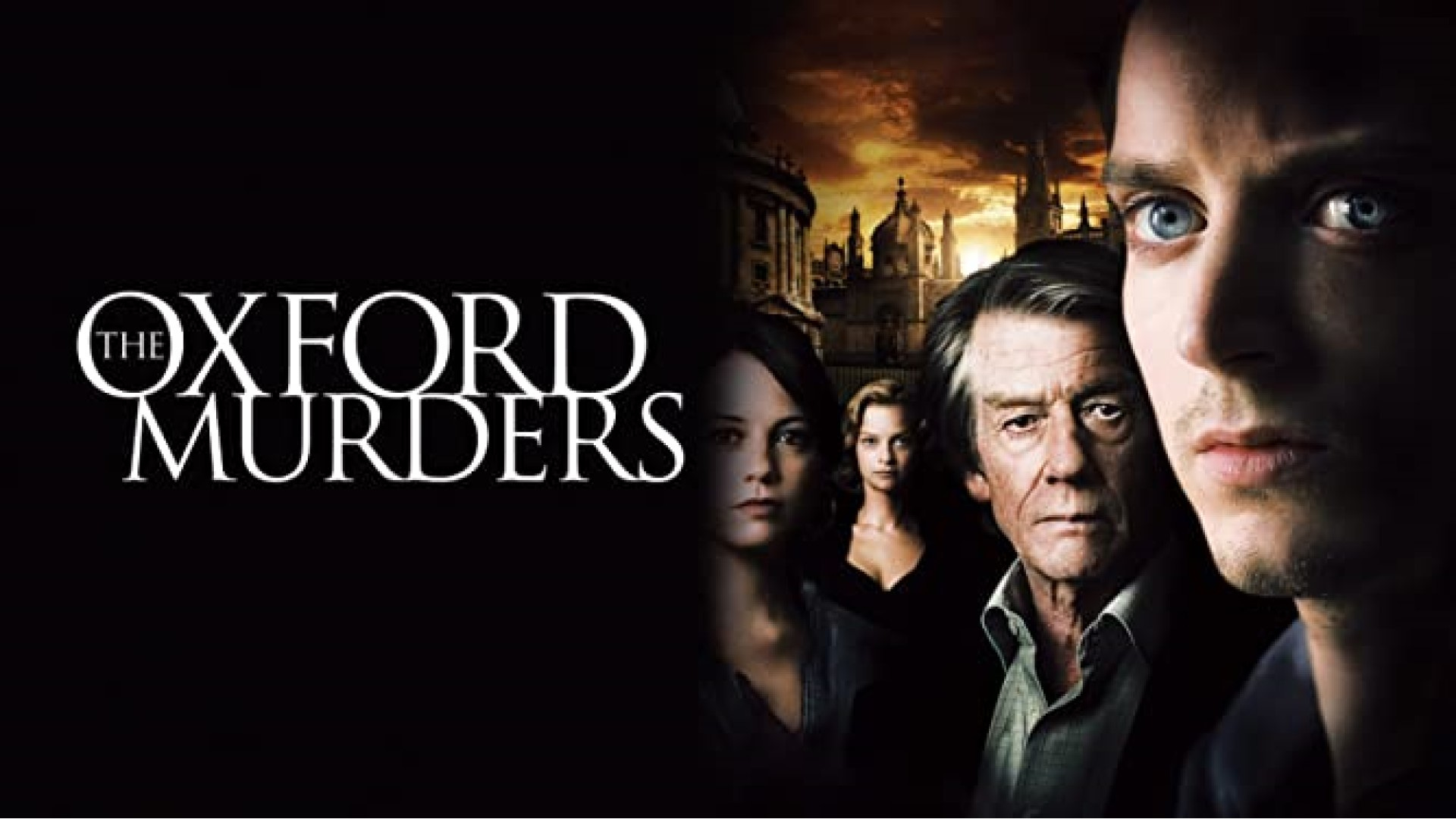
The story begins when American graduate student Martin arrives in Oxford, hoping to convince the great logician, Professor Seldom, to serve as his supervisor. Seldom initially refuses him and is portrayed as being more concerned with his books and research, than with mentoring students. Seldom reluctantly joins forces with Martin when they are confronted with the murder of Martin’s landlady, Julia Eagleton, an elderly woman and longtime friend of Arthur.
Seldom finds an anonymous note left by the killer with the words “the first of a series,” followed by the elderly woman’s address and a cryptic drawing of a circle, which the professor immediately assumes must be the first of a logical series. They believe the killer is trying to provoke Seldom.
Subsequently, an apparent assisted suicide, a natural death, and a murder occur. All of which are preceded or followed by cryptic clues involving mathematical symbols, logical fallacies, and philosophical references, suggesting the killer is challenging Seldom and Martin to stop him through sheer intellect. Seldom and Martin desperately try to predict the next target based on the sequence. During their investigations, they visit a former student of Seldom, who attempted to lobotomize himself. Concurrently, the police investigate some of these and fumble.
The film ends with a plot twist, which challenges how the viewer sees these murders. What first seemed like a cryptic and murderous battle of wits between the mathematicians turned detective duo and the killer; ends up in an equally disturbing series of coincidences, tragedies, and manipulated crimes.
The Patterned History of Medicine
The killer’s logical series begins with a circle, which Seldom claims represents infinite possibilities. The second symbol is an Ichthys (the early Christian fish symbol), and the third is a triangle. Eventually, the series is linked to the tetractys, a triangular figure composed of ten points arranged in rows of one, two, three, and four, symbolising numerical harmony in the Pythagorean tradition.

Upon this discovery, Martin and Lorna, a nurse and Seldom’s former lover, connect the murders to Pythagorean symbolism. They speculate the next target will be a group of people, likely those with disabilities. Lorna explains that the Pythagoreans viewed intelligence as a form of superiority, implying that those of lower intelligence could be discarded or used as test subjects for medical advancements, such as organ transplants. They suspect Frank, a bus driver at Lorna’s hospital, whose daughter needs a transplant. They fear he intends to sacrifice a busload of children with disabilities to ensure his daughter’s survival, alluding to issues of systemic injustice2.
Severing The Self Through Psychosurgery
The destruction of identity through neurosurgical interventions is a powerful theme in this film. The lobotomized characters are depicted as shells of their former selves. For example, Kalman, a former prodigious student of Professor Seldom, tries to lobotomize himself with a nail gun.
Kalman claims valid reasons for this drastic measure. His obsessive efforts to solve Gödel’s incompleteness theorems rendered him unstable, a condition worsened by a diagnosis of aggressive cancer. He came to view lobotomy as the ultimate escape; the only valid recourse from a world where certainty is impossible. After failing to convince Seldom to assist him in this brain-severing operation, Kalman used a nail gun on himself. Despite this self-inflicted trauma and his physical decay from cancer, he remains caught in a loop, incessantly writing the same four letters and a woman’s name.
During Martin and Seldom’s visit to Kalman, Seldom explains that a study of what comes next in a series found that a third of the answers that appeared silly were, in reality, very complex. The student wanted to test this on lobotomized patients because they are remarkably simple. Perhaps Kalman sought the lobotomy to clear his mind
Even though Kalman’s story features a physically disturbing portrayal, his lobotomy carries a metaphorical message: intellectual suicide. Kalman seeks to answer the unanswerable questions of the universe, and during his pursuit, he loses himself. This loss is also manifested by his progressive physical decay and deformity. He eventually decides to commit the severing of the mind, destroying that which makes him human.
The film appears to be criticising human ambition and the destructive nature of psychosurgery. The film depicts Kalman as grotesque, unlike other lobotomized patients. This possibly hints at the folly of trying to conquer knowledge.
Policing and Incompetence
The film portrays the police force in a decidedly negative light, depicting detectives as ignorant, misguided, and incompetent.
When Julia Eagleton is found, Seldom and Martin are disappointed to find the police do not understand the concept of a symbol or a logical series. Seldom dismissively explains that in such series, symbols must follow a specific order. While Seldom argues that “murder for intellectual reasons does not exist,” Martin insists the killer is challenging them. Martin notes that the murderer chose a victim whose death would not be surprising; the fact that the academics notice this, while the police do not, reflects poorly on the detectives.
This incompetence is reinforced through an anecdote Seldom shares about a man named Green. Green was killed by his wife in self-defense, but he had kept a diary outlining brilliant and absurd ways to kill her. The police were misled by the diary, which turned out to be a forgery written by the wife’s lover.
Throughout the film, the police continue to stumble. The police psychiatrist bizarrely suggests the killer is a repressed homosexual longing for Seldom. Later, a police plan to publish part of the series to flatter the killer’s ego fails miserably. When Martin rushes to the police believing he has solved the pattern, he is told Seldom beat him to it, implying the police are merely bystanders to the intellect of the two men. Finally, when the suspect’s bus crashes and explodes, Detective Peterson smirks, “So much for logic,” wrongly assuming the driver died while trying to escape.
The Resolution
Believing the killer to be dead, Martin decides to leave the UK with Lorna, but remains obsessed with the killer’s logical series. Briefly before boarding, he takes out his notes and, upon further inspection, realises Seldom lied about his understanding of the series. Lorna leaves, realizing Martin won’t let this go, while he heads out to confront Seldom.


They meet in a museum, where the truth is unveiled: Arthur Seldom knew the killer all along. He had been covering up the first murder when Martin unwittingly gave him the idea for the logical series to mask the crime. Seldom reveals that Beth killed her mother, Julia Eagleton, feeling enslaved by her care. She wanted to be with Martin, who had encouraged her to live freely. Seldom muses that Martin’s words were the “butterfly’s wings” that provoked a tornado, calling back to a discussion on chaos theory they shared when they first met.
Conclusion
The Oxford Murders is an interesting blend of murder mystery and plot twists wrapped in a veneer of academia. However, its critique of institutions - academic, policing, and medical - often feels superficial. The most glaring flaw is the unrealistic and poor interpretation of detective work. Conversely, the film offers a shallow yet compelling critique of medical ethics through Frank, a victim of a broken system, and Kalman, a man captivated by lobotomy regardless of the cost. Ultimately, the most profound theme explored is the pervasive power of human hubris: the search for prestige and the testing of boundaries often yield disastrous outcomes for everyone involved.
There are significant differences between the book and the film. For this post, we essentially focus on the film.
It is worth noting that in Guillermo Martínez’s novel, Frank’s motivation includes avenging his sister, who was left impaired after being improperly lobotomized.