


I find myself thinking more about immigration than I ever thought I would. Recently, the discourse on crime has been closely tied to that of immigration. In this post, I want to create a fictional scenario to explore this issue.
Enter Mars and the Fabulous Martians
Mars is a beautiful and advanced planet. Martians have created a modern, science-based state with excellent systems, structures, and safety. This thriving community of Martians has experienced economic prosperity and improvements in quality of life. Such success has created the need for labour, and Martians are reluctant to accept some jobs.

In contrast, Jupiter has not had such success, and Jupitarians, especially those residing in Ganymedes, one of the moons, have been emigrating in search of a better life elsewhere.
At first, Martians did not take particular note of the aliens from Ganymede, but recently, they have become concerned about the pesky Jupitarians from Ganymede.
Life on Mars is better than it has ever been. Nevertheless, Martians are increasingly anxious about safety. How are aliens from Ganymede impacting life on Mars?
The following imaginary scenario may give the impression that we are biological essentialists who think that biology determines behaviour. We are not. Behaviour is a complex phenomenon in which genes, environment, and experience interact. In this scenario, we take such a deterministic, unrealistic approach to behaviour to highlight questions about the impact a group of aliens may have on another group.
For the sake of argument
Let us imagine that:
Ganymedians commit 10x more robberies/assaults than local Martians.
Imagine a population of 10 million Martians (M)
They share Mars with 100,000 people from Ganymedes (G).
Last year, there were 10,000 crimes committed on Mars.
In this scenario, Ganymedians would be responsible for 909 crimes out of a total of 10,000, so police initiatives targeting them could, at best, have a marginal effect on the total number of crimes. Even eliminating all Ganymedian crime would reduce crime by about 10 per cent. In contrast, an initiative that reduced Martian crime by ten per cent would reduce the same number of crimes.
The Martians worry about more aliens from Ganymedes. However, for the total number of crimes to increase by another ten per cent, over one hundred thousand new aliens would have to arrive.
These are not insignificant numbers, but they suggest that any effective crime-reduction strategy would target the majority of crimes rather than focus on a small subset.
Spending resources on a population that commits a small fraction of all crime would likely have a smaller impact on reducing crime than initiatives that target all those who commit crimes. Thinking about the effects of interventions is essential to devising policies that improve everyone’s lives.
If we keep imagining these martians… we may find that
At the current population level, Ganymedians would need to have a crime rate 33 times that of Martians to account for 25% of all crimes.
Alternatively, increasing the Ganymedian population by a factor of ten would still mean that Ganymedians accounted for less than half of all crimes.

In these scenarios, for every 100,000 new Ganymedians, crime would increase by 2%, but Mars would gain tens of thousands of productive workers.
You should recall that for this thought experiment, I set the Ganymedians’ crime rate to 10 times that of the Martians.
Does This Help Us Think About Real Life?
I want to raise an issue rather than answer a question. Hence, I am not going to collect extensive data for this section, but such a project could be worthwhile.
In the United Kingdom, Nigel Farage has claimed Afghans are 22 times more likely to be convicted of rape than people born in the UK, but the numbers do not support his claim. For example, between 2021 and 2023, seventy-seven Afghans were convicted of sexual offences in comparison to over fourteen thousand people born in the UK. If we look at arrests broken down by ethnicity, we find that the highest arrest rate is twice that of the lowest. Likewise, our post relying on ChatGTP found that incarceration rates for certain immigrant groups are rarely higher than five times that of locals.1

The scenario about Martians and Ganymedians should encourage us to think about our own societies and which policies can make a difference. There are no real Ganymedians, but if they were, they would not be solely products of their biology.
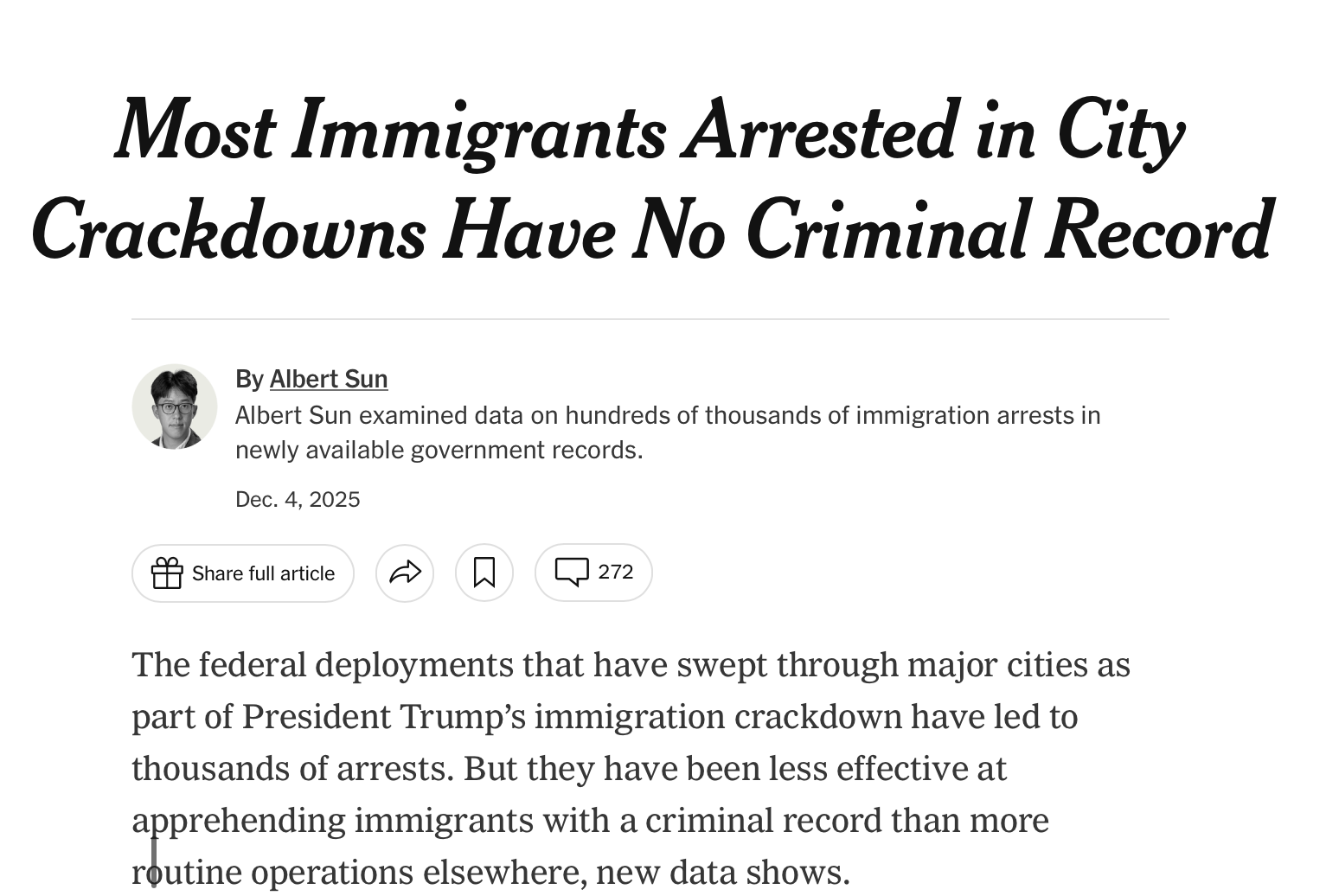
The New York Times published a study based on hundreds of thousands of immigration arrests and found that most of immigrants arrested have no criminal records. Less than a third have ever been convicted of a crime. These convictions include certain traffic violations. In contrast, during President Biden’s last year in office, 63% of those arrested by ICE had criminal convictions. One could ask whether these efforts are a good way to spend resources.
Last December, we published a post expressing concern that the discourse about immigration and crime tends to focus on certain kinds of crimes, and thus obfuscates other types of crime that also negatively impact everyday people.
INSERT LINK.
Conclusions
In a world with limited resources, we need to make choices about how to spend our time, money, and influence. In this week’s essay, I wanted to share a thought experiment that may help us consider crime and immigration dispassionately.
Populist leaders often blame immigrants for the problems their society faces and claim that they are primarily responsible for crimes. This fictional scenario can help shift the conversation about crime and efforts to reduce crime.
Certain crimes can be devastating to victims and can create a sense of danger even if that perspective is misaligned with reality. For example, many Americans are fearful that American cities are crime-ridden, even when data suggests crime has significantly decreased. Further, these conversations ignore a series of other crimes which could be essential to consider in crafting a more perfect union.
We should consider policies that help us build a better society. This requires engaging in dialogue and examining which interventions are more likely to succeed.
I first investigated immigration for a research methods course at Harvard Extension School, where I wrote about Italian immigrants and the most restrictive immigration act in American history.
In Old Fears, New Foes, I found that anti-immigration sentiment against Italians used science and medicine to justify pre-existing anxieties about immigration. The project turned into six articles, including one in which we summarised the rest in light of current events.
Afraid of the Other: Revisiting Old Fears, New Foes

Back in August 2023, we published a series of articles about the history of Italian immigration to America during the early 20th-century. At this time, politicians and influential thinkers made use of scientific and medical arguments to justify their pre-existing anxieties about immigrants
I am sceptical about the accuracy of these numbers. Please beware. In another article, I asked ChatGPT to collect data on the US Presidential elections, and much of what it gathered was incorrect. For that article, I checked each number, but for this one, I did not first, because of my lack of experience and misplaced confidence in LLMs. I stand by the analytical approach and think many of the points hold even if the numbers are slightly off.
This is a wonderful piece! Nice approach to the subject…