


The ongoing discourse about immigrants is often related to the claim that immigrants are disproportionately responsible for criminal activity. While this claim is worth exploring, this focus distracts attention from other crimes, which likely have a bigger effect on everyday people doing everyday activities.1
For example, President Donald Trump claimed America is becoming a
“lawless, open borders, crime-ridden, filthy, communist nightmare.
This week’s post is an invitation to broaden our discourse about crime.
My Phone Was Taken! Deport the Criminals?
The ongoing focus on petty crime and pickpockets takes over our conversation, and other systemic and structural issues can be ignored. There are countless cases where such robberies are linked to alleged immigrants, for example, in this video.
No one likes being robbed.
Seeing someone point a gun at you is, to put it mildly, no fun.
When I was eighteen, my mom and I were heading to dinner. We stopped to pick up one of her friends. I got out of the car to ring the doorbell, and out of nowhere, a group of men wielding guns appeared. One gun was pointed at the driver. Another of the men pointed a revolver at my mother. A third robber aimed his gun at me.
My mom was terrified that this was a kidnapping and not a robbery. She calmly told them she had lots to give them and offered her camera, her phone, and her jewellery. They told me to squat.
During the robbery, the thieves said “please,” and even thanked us for the stuff we surrendered. It felt long, as if every second somehow expanded, stretched, and expanded.
Then they were gone.
We suspected they were off-duty policemen because of the slang they used. Living with the fear of being robbed or being hurt in the process of being robbed is not a good way to live2.
I do not want to lessen the pain, fear, and worry that regular crimes can cause. I’ve known several people whose houses have been robbed. Such events violate the assumed sanctity of our homes, the place where people tend to feel safer. These experiences can be difficult to overcome, which is why perceptions of crime can significantly affect how safe a community feels.
As a society, we should address and strive to mitigate these crimes, and, more importantly, ensure they do not become violent.
Such crimes can have devastating effects on a community if they reach a point where community members no longer feel safe living their everyday lives, doing everyday activities and errands. On the other hand, a small number of such crimes likely have little effect on the day-to-day life of non-victims.
I want us to keep talking about these crimes, but also consider how other crimes are affecting the societies we live in.
Bigger Crimes?
Crimes at the highest echelons of nation-states arguably have a much greater impact and scale than other kinds of crime. Recently, President Nicholas Sarkozy of France and President Jair Bolsonaro of Brazil were sentenced to prison. Sarkozy seems to have convinced the courts he ought to be released, while Bolsonaro’s latest appeal was rejected. He is serving a twenty-seven-year prison term for plotting a coup. The current President of Brazil (Lula) had been sentenced to prison for corruption, but his conviction was recently overturned. Peru has impeached three Presidents in five years, amid corruption and ethical scandals. Looking at heads of state is worrying enough, and their roles and responsibilities make them profoundly impactful.3
The corrupt actions of these heads of state arguably have a bigger negative impact on their societies than a few pickpockets. When leaders have even more power, the situation appears more dire. North Korean dictators run totalitarian states, and President Putin has broken international law by invading Ukraine. Putin’s war potentially risks a big European war, which would affect millions more.
There are other cases where corrupt governments have negatively impacted their people. Mismanagement of public funds for private enrichment, or the adoption of policies driven by a political or lobbyist agenda, can hinder the development and progress of tens of thousands of people, sometimes spanning generations.
Big Firms, Big Crimes
In some cases, big companies can and do hurt people. Some big companies employ many people, comply with the law, and make efforts to have a positive impact. I do not mean to suggest that such companies are all good or all bad, but rather that, in some instances, they take actions that harm people. Some of these actions are corporate crimes.
In some cases, companies that prioritise profit over responsible operations have sometimes engaged in criminal activity. Naomi Oreskes, in her magisterial Merchants of Doubt, documented how tobacco companies knew cigarettes caused cancer, and worked on confusing the public so they could continue selling cigarettes. Similarly, big oil has also spent millions trying to combat science that suggests climate change is occurring. Numerous other ideas have caused harm, and people’s vulnerability has been exploited for profit. There is a site that collects information on the harms caused by various pseudoscientific ideas.
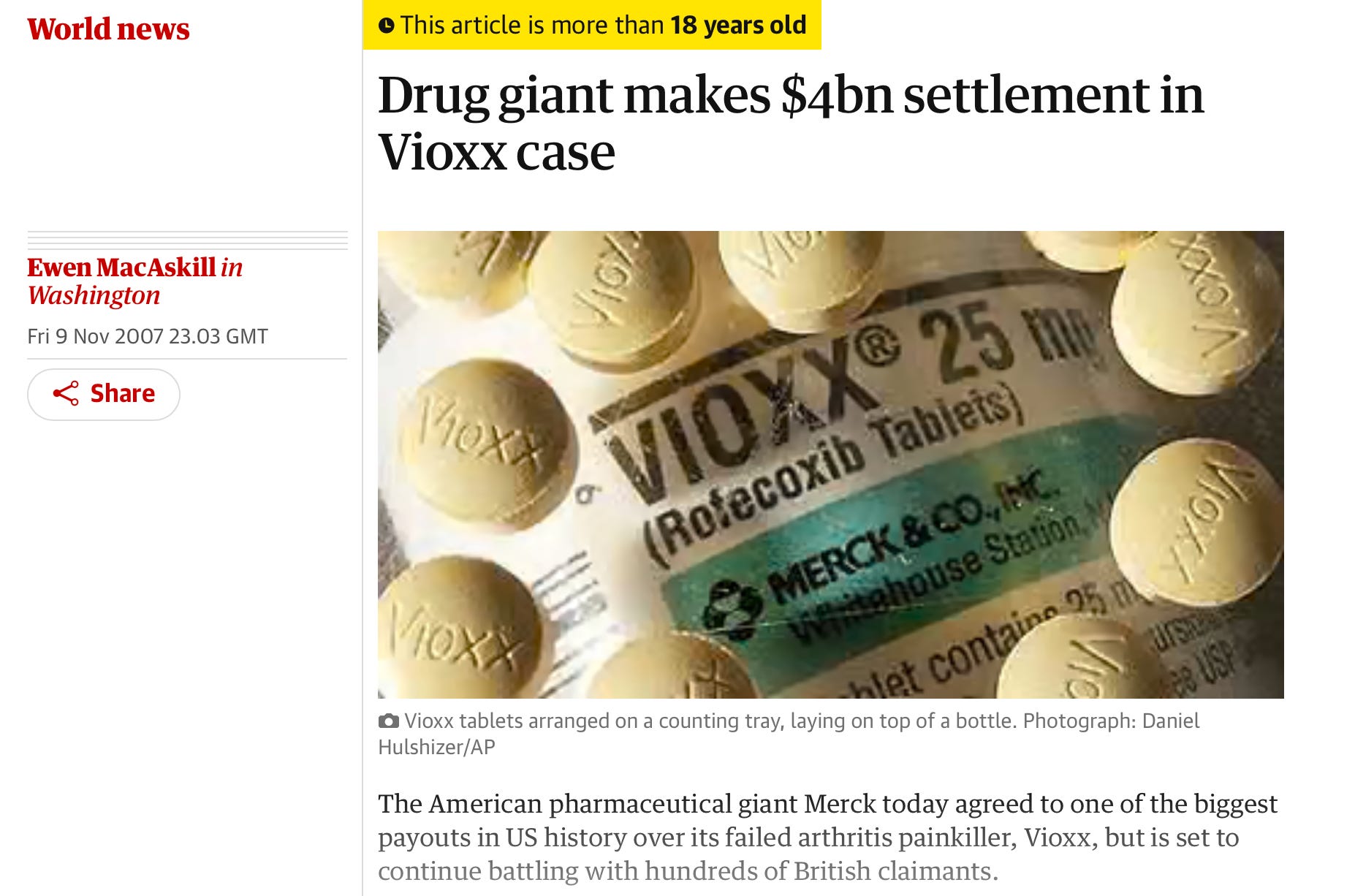
The modern medical establishment also has its share of criminal actors. Big pharmaceutical companies have also been accused of massaging data, even when people were suffering. Merck allegedly manipulated data to hide an increase in cardiovascular disease in people taking Vioxx, a medication to treat arthritis. Some experts have estimated that over fifty-five thousand people suffered early deaths as a result, and another study estimated this medication caused cardiac events in over 150.000 people. Ben Goldacre’s Bad Pharma is a masterful critique of ongoing medical malpractice.
Financial crimes can have a significant impact on everyday people by harming the economy and their livelihoods. One could begin by examining Ponzi schemes like those of Bernie Madoff and the speculative investing that led to the latest financial crisis. Several significant insider trading cases have hurt investors. Many homeowners lost their homes. Sometimes companies mishandle people’s data; for example, Facebook accepted a $ 725 million settlement over the Cambridge Analytica scandal.
Surprisingly, the individuals involved in these crimes are often from the very same countries that are being harmed.
Let me be clear: most kinds of crime hurt society and make life harder for everyday people. This brief detour is a reminder that other types of crime exist and can, conceivably, have a more harmful impact on communities. It is a call to broaden our conversation about crime and a reminder that focusing on certain crimes at the expense of others can be detrimental.
Do Immigrants Commit More Crimes?
In a previous post, we sought to determine crime rates per capita across different groups in Spain.
We, somewhat lazily, prompted ChatGPT to find data and then made some assumptions to calculate crime rates per capita for immigrants from various nations.4 ChatGPT collected the data, so one should be sceptical. It showed that some groups have a slightly higher per capita rate, but the difference was not very large. A fair comparison must exclude people below and above a certain age, as well as a few others who are unlikely to commit crimes, to avoid skewing your analysis.
Europe at a Crossroads: Immigration, Crime and Integration

The refugee crisis that has affected Europe for over a decade, led to a considerable increase in popularity of anti-immigration political parties. For example, The National Rally in France, the AFD in Germany, Party for Freedom in the Netherlands, and
In a later post, I want to explore the impact immigrants may have on crime rates.5
In some countries, certain immigrant groups are admittedly causing trouble. One can think of Eastern European gangs in Sweden. Are many of these individuals second-generation immigrants, and if so, what has gone awry?
Recently, the good thinkers at Cymposium published a series of articles on immigration and developing a sense of belonging. Sometimes, local populations could do more to help newcomers settle and grow.6 Would such efforts reduce the problems these people allegedly create? In another article, they engage in a thought experiment about Britain’s future to illustrate the choice ahead:

Often, the conversation about immigrants ignores the fact that most crimes are committed by locals, simply because there are a lot more locals. A British study between 2017 and 2020 found that about 80% of sexually assaulted women were attacked by someone they knew. In contrast, male victims are assaulted by strangers about 43% of the time.
Nation-states need to consider their long-term interests and evaluate which factors may increase the likelihood that an individual, whether a national or an immigrant, engages in criminal behaviour. Policies that effectively decrease such a likelihood should be embraced. I would urge
Avoid making immigrants a scapegoat.
Make evidence-based decisions.
Both John Shjarback and John Roman have written extensively on this issue, and their formidable substacks are a must for those interested in thinking deeply about crime.
Evaluate the impact, including costs & benefits, of each intervention.
I suspect most immigrants are law-abiding and contribute to our societies.
We can recognise that illegal immigration is a problem, and that several illegal immigrants are essential to our society working well. Often, illegal immigrants take jobs that locals are unwilling or uninterested in taking.
What is needed is immigration reform and deep thinking about how to ensure our societies can operate without the recourse to illegal immigrants.
I wrote and scheduled this before my surgery on November 28th. Hoping to see all your reactions to the essay.
This happened back in 2004. I think we were out for my mother’s birthday, and my dad was waiting for us at the restaurant with everyone else. At the time, I lived in Peru.
This section could be infinitely long.
I am sceptical about the accuracy of these numbers. Please beware. In another article, I asked ChatGPT to collect data on the US Presidential elections, and much of what it gathered was incorrect. For that article, I checked each number, but for this one, I did not first, because of my lack of experience and misplaced confidence in LLMs. I stand by the analytical approach and think many of the points hold even if the numbers are slightly off.
Here, I engage in a thought experiment in which I imagine that Martians are real and are discussing what to do about the ongoing flood of immigrants from Jupiter. Maybe this is a waste, a foolish exercise, though sometimes such silliness can help us think.
If you do not Subscribe to Cymposium, I urge you to take a look. They produce insightful articles on a wide range of relevant topics. They’ve discussed the role and responsibilities of former empires, the importance of developing a sense of belonging, and the paradox of integrating others.
This essay usefully widens the frame. What becomes visible when we do that is that the most damaging forms of crime are not episodic or opportunistic, but systemic—emerging when power is insulated from honest feedback. Across governments, corporations, and institutions, the same pattern appears: certain leadership profiles experience oversight, constraint, and dissent not as safeguards, but as threats. Once those profiles dominate, systems quietly re-optimize around loyalty, narrative control, and self-protection, while accuracy and public benefit degrade. This helps explain why large-scale harms recur across countries and ideologies, even where laws and cultures differ. Broadening the conversation in this way doesn’t minimize everyday crime; it clarifies why addressing surface symptoms alone leaves the deeper sources of harm untouched.
Thanks for the shoutout from one of our favorite substackers, and glad to hear that you're up and about after your surgery!
Having a gun pointed at you and your mother must have been scary, regardless of how 'professional' the robbers were. It's the difference between a few pounds of pressure on that trigger after all....
Immigration and immigrants to the Western world is definitely a hot button topic nowadays, and we can't just brush it under the carpet or ignore it and hope it'll go away anytime soon. It's one of those things that need to come to a head with a solution, though historical precedents tell us that it doesn't always end well....I guess we'll see what happens...