


The use of murder scene plans in courts and in the press changed during the 19th century.1 Crime scene models provide a visual representation of where a crime allegedly took place. Like any model, the model maker must decide what to include and how to portray it. These scenes can suggest a narrative rather than offer an impartial view.
The Crime Scene: Visual Models and Persuasion
Expertise and visual models shaped courtrooms and public perception.
In 1806, The Times published a woodcut depicting the scene of Isaac Blight’s murder, which is often “regarded as the first publication of a crime scene sketch.” What made this crime so different and important that it merited a front-page sketch of the scene? Helen Rutherford and Clare Sandford-Couch argued that this demonstrates an increased “awareness that the scene itself was important to understanding what had happened.” They suggest this was a “significant innovation” in crime reporting.
In 1806, Richard Patch was convicted of murdering Isaac Blight based, in part, on a crime scene model. Blight was shot on September 23, 1805. The trial drew large crowds, and a Royal box was set aside so royalty could attend. No one really knows why this trial drew so much attention. Perhaps it was Barrister Garrow’s fame as a prosecutor. However, this seems unconvincing. The murder and trial seem otherwise unremarkable.
Rutherford and Sandford-Couch have investigated the case and said that the evidence against Patch was circumstantial. In addition, he had an alibi. Despite this, Garrow used a crime-scene model to successfully argue that the house’s layout meant Patch was the only one who could be guilty. Rutherford said she does not think the scene shows what Garrow implied.
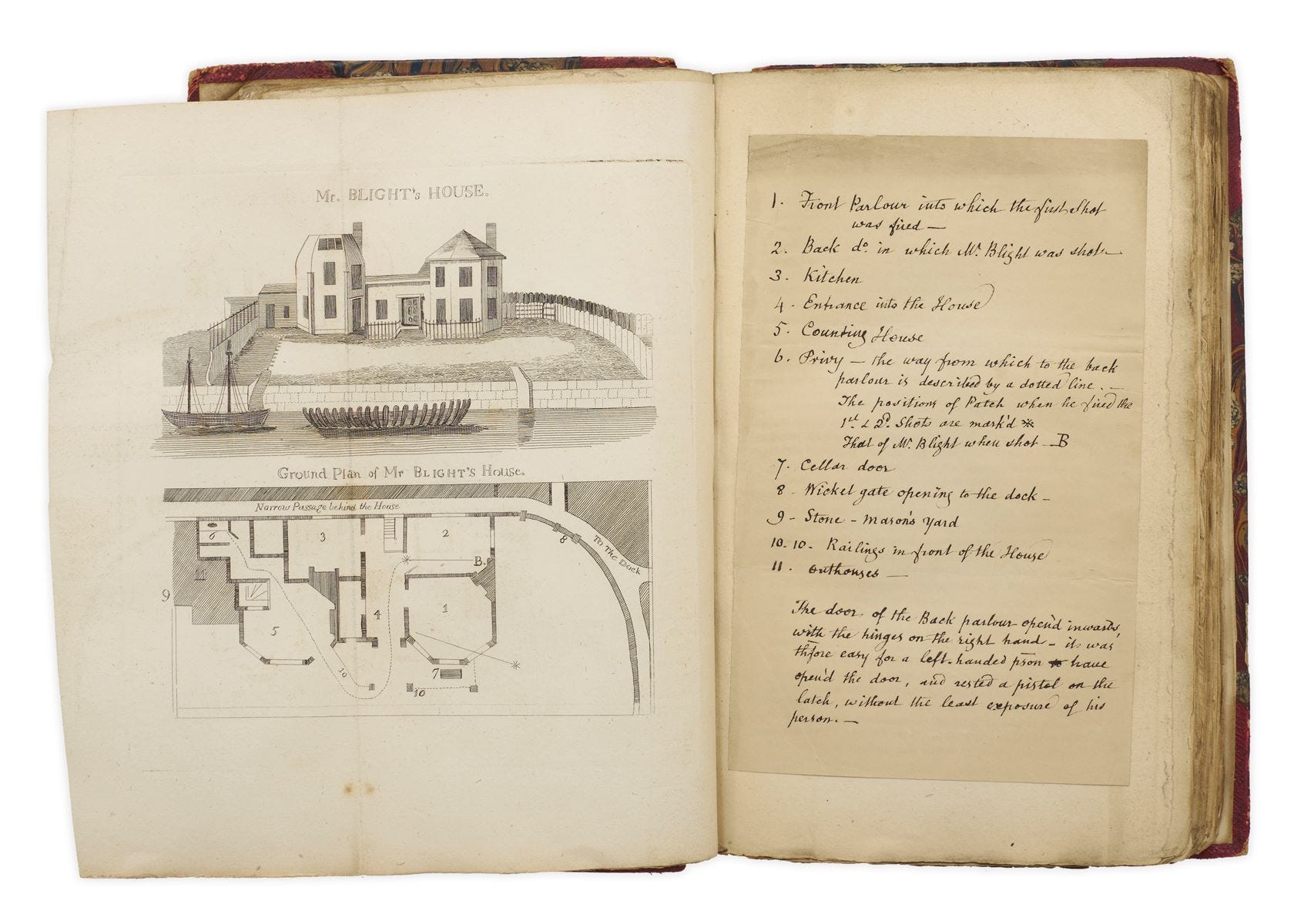
The model played a crucial role in the trial. Garrow’s perception of the model’s importance is evident in his making at least five references to it during his opening remarks. However, the model’s veracity had to be established. The model was based on a plan originally prepared by a surveyor who testified to the plan’s accuracy. This testimony was vital because the surveyor’s oath attesting to its accuracy made it admissible as evidence. Such visual representations allowed evidence to be mapped into a crime scene where competing narratives could be imagined.
The model leapt out of the courtroom into the national press.
On April 7th 1806, The Times published the scene on its front page. The paper included two images. The top one showed the building, and the second one was a detailed woodcut of the scene. What was new was the second part: a new kind of image that included a detailed plan of the space and a key to guide the reader. This presentation felt factual and imparted useful knowledge rather than sensationalising. This was a new way to report, offering a new way to consume crime.
The image made readers and viewers into active thinkers.
Readers could draw on their practical experience to make extrapolations and make sense of the scene. They saw room outlines and could follow the key to navigate the scene. They could thus follow the killer’s alleged path and turn this 2D representation into a three-dimensional one in their minds. These historians suggest that this new imagery made readers into invisible witnesses and invited them to reconstruct the alleged events and reach their own conclusions.
Such an image must have required considerable resources, as it was published on the Monday after the trial, which was held on a Saturday. The first image the paper ever printed was in January 1806, making this crime scene one of the earliest images it used. As a national paper, The Times included this story, assuming a wide range of readers would be interested. Other newspapers also reproduced the scene with “varying accuracy.” Thus, the plan inspired multiple, differing woodcuts, suggesting that newspapers commissioned their own. Despite the success of this crime-scene image, the Times did not print another.
A model based on a murder-scene plan. Garrow used the model to propose a narrative. The surveyor legitimised the plan by attesting to its alleged veracity. What we may think of this evidence is less important than seeing that they found it persuasive. For them, it constituted evidence.
Experts and Evidence
Studying the rise of expertise and the use of new tools in prosecuting alleged criminals allows us to see these changes. Certain claims seem convincing and legitimate because recognised authorities support their veracity, which our future post on poisoning will echo. This example shows the power of models and how they become convincing. In this case, non-experts may think through the suggested models and, when presented with one, forget the possibility of others. The lesson is not to dismiss expertise and models. Instead, it calls for thoughtfulness and curiosity.
This article is based on a panel held at the British Crime Historians Symposium, held at Oxford Brookes on September 3-4. The article is based on published abstracts and my notes. I am therefore responsible for any mistakes that may have crept in or for any claims I may have unknowingly misconstrued.