


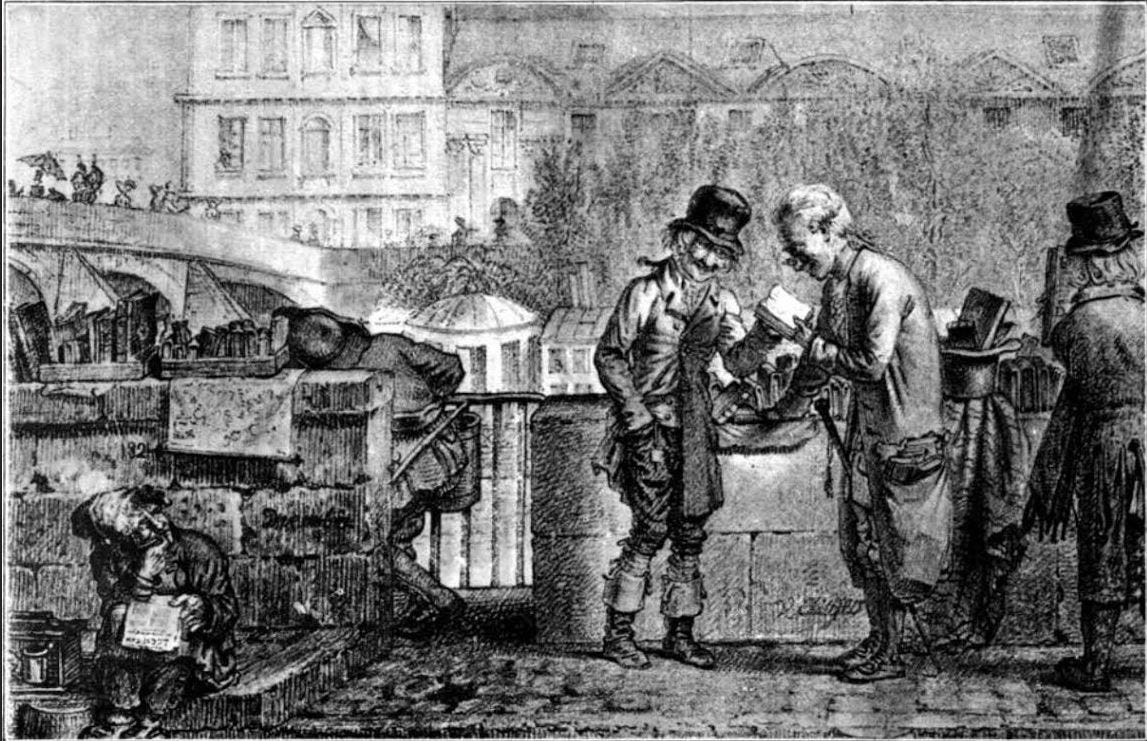
Many Western societies became increasingly concerned about crime in the 19th century. This coincides with urbanization and industrialization and fears about how cities corrupt people. Their efforts to understand crime and ensure the safety of their societies entailed a radical shift in how they explained why some people committed crimes and in how they sought to reduce crime.
Today, we will explore this shift through the French Revolution and Victorian Judges. During this time of change, there was a belief that “humans possessed free will and rationality, so [criminals] had chosen to commit crimes” (Sellers, p.32).1
In the first example, the French Revolutionaries believed that rational laws would eliminate crime, and failed. Secondly, Victorian judges used a conceptual model of a reasonable man to help them make their rulings.
Making Better People: The French Revolution and The Effort to End Crime (Marc Renneville).
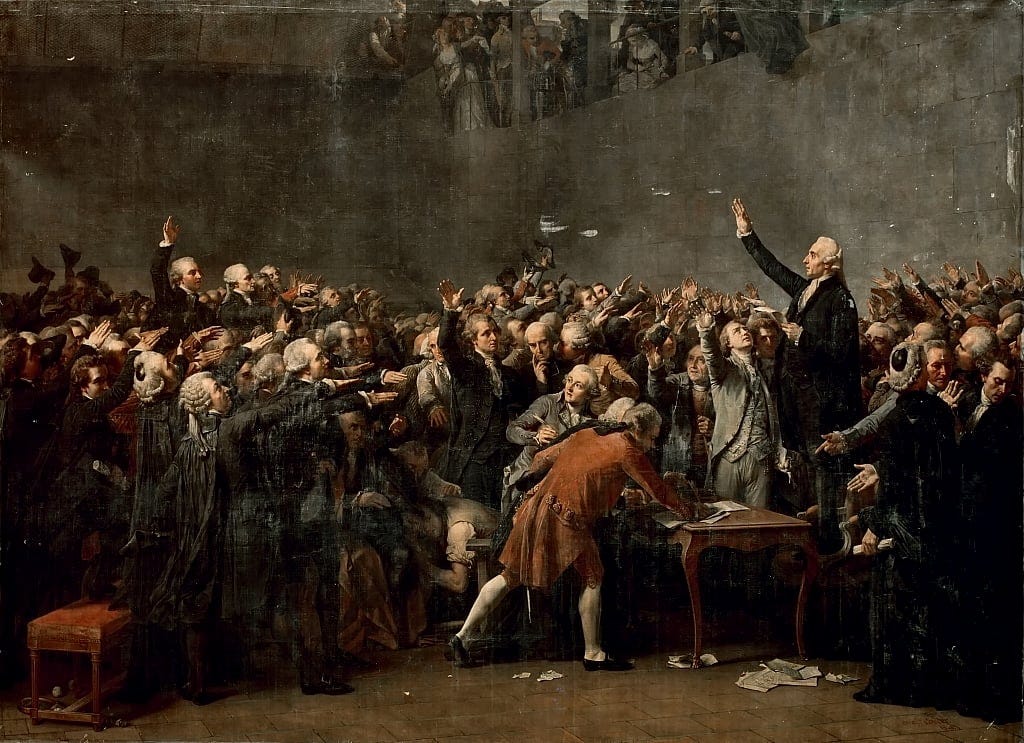
One undeniable characteristic of the early French Revolution was an unwavering belief that reason would solve all of France’s problems.2 The revolution’s efforts to dethrone the church opened the space for new expert and their explanations need not be related to moral theology (Renneville).
Enlightened thinkers, at first, suggested that crime could be eradicated through the creation of new laws which would remake society (Becker and Wetzell). Marc Rennevill, a historian, argues that after the swift failure of laws intended to remake people, the State adopted laws to preserve the newly established society.
Pre-revolutionary Explanations
Before the revolution, Enlightenment thinkers argued that people committed crimes because of “badly organised secular institutions” (Renneville p. 30). They suggested that individuals could not be expected to obey the law because it was too harsh and often arbitrary. They suggested that people committed crimes because it was rational because the law did not benefit them, and thus, why would any reasonable person abide by it? Rather than appealing to differences between people, they pointed to judicial and social abuses as the causes of crime. In contrast, they posited that just laws would effectively reduce crime.
I suggest that this view implies that man is rational, and thus, that any person breaking the law has made a rational decision to do so. From this perspective, there are no meaningful differences between people who commit crimes and those who do not. Both are capable of responding reasonably to their circumstances. Both are capable of changing their behaviour.
Post Revolutionary Changes
The adoption of distinct criminal codes reflects different views regarding the aetiology of crime (Renneville). A new criminal code introduced in 1791 established fixed punishments for crimes. Other thinkers, like Pierre Jean Georges Cabanis (1790), claimed that prisons would be “infirmaries of crime,” after learning about a prison in Oxford County that allegedly rehabilitated criminals through work (p.35). Cabanis thought that a person’s physical traits (age, sex, and other features) could affect their sensations and, thus, their ability to think, opening the door to the future introduction of extenuating circumstances.
Renneville claims that after new laws were introduced, crime did not fade. This presented a problem because these reformers had suggested that people committed crimes because the regime was oppressive. According to their way of thinking, once the oppressive regime was gone, the persistence of crime could no longer be explained through oppressive laws.
Criminals, unlike the insane, were assumed to be capable of reasoning, and thus the question of why they committed a crime lingered. In trying to answer this question, thinkers sought to understand the nature of the criminal.
These failures to curb crime led to the enactment of new criminal codes in 1808 and 1810. Unlike the first ones, these sought to preserve society rather than recreate it (Renneville). At the time, some thinkers suggested that as society progresses, perhaps certain individual values wane. French thinkers began looking at criminals to explore why they committed crimes. In the case of France these changes happen in medical and legal settings.
Renneville’s argument is cogent and raises important questions regarding how societies address social issues. In the case of France, revolutionaries dispelled religious authorities who would have otherwise been part of the conversation. Importantly, their assumptions about human nature crept into their explanations and the solutions they devised.
Unwilling or Unable: Victorian Judges and Criminal Responsibility

Early Victorian Judges assumed that all men were similarly capable of committing a crime and of resisting the impulse to do so (Weiner p.45). Martin Wiener argues that they established a reasonable man standard from which they judged individuals. Weiner contends that this view was eventually undermined, and the question became whether criminals were unable or unwilling to control their criminal impulses.
Weiner holds that both views make different assumptions about human nature. In the first case, the assumption is that most individuals are reasonable, whereas in the second, the assumption is that there is a difference between people who commit crimes and those who do not.
Fifteen High Court Judges adjudicated all serious criminal offenses in Victorian England. The judges sometimes spoke at Court, which was reported by newspapers. More often, they corresponded with the Home Office, which had to determine whether to carry out capital punishments or grant clemency. Using these sources, Weiner reaches some conclusions about the birth of British scientific criminology.
An Expectation of Violence
Reacting violently to certain “disgraceful behavior” was socially “expected” in the late 18th century (Weiner, p.50). Nevertheless, as England entered the 19th century, people became less tolerant of violence as the culture of honour waned and a growing interest in how passions affected behaviour emerged (Weiner). During that time, Victorian England saw drastic material and social changes, and Judges were left having to apply case law to a changing society. In doing so, they reified ideas about self-control, reason, and the perfectibility of man.

Reasonable Men
19th-century jurists believed that all people had the potential to make rational decisions in their long-term best interests. According to Weiner, this understanding of human nature led them to judge cases by considering whether a reasonable man would have acted similarly. Therefore, determining whether the act was reasonable superseded considerations about the culprit. Weiner’s claim rests on the reasonable man concept, even if it was not explicitly used by these historical actors. Such an assumption opens space for experts to contribute to defining what is reasonable. In a later post I will discuss Victorian convict prisons where pragmatic concerns about running prisons often dealt with similar questions.
According to Weiner, this standard also changed the way in which criminals were defended. Some lawyers claimed that the reasonable man standard was too broad and that a person’s actions should be judged in light of their character. For example, a person known to be hot-headed should be judged differently from someone known to be calm. This strategy mostly failed in court.
While this is interesting it is important to note that the reasonable man standard was not verbalized as such. This is an analytical category that Weiner has devised to think about the way in which these historical actors reasoned.
An Alternative Strategy: Not All Men Are Reasonable
Other lawyers claimed their clients were not reasonable because they were insane. This strategy was more successful, especially after a liberal government gained power in 1880.
Weiner concludes that this strategy was more successful because it did not challenge the underlying assumption that most men are reasonable. His research shows that, between 1860 and 1900, there was a significant increase in the number of perpetrators being found insane despite a decrease in the number of murder trials. This development required professionals to determine whether the accused was sane.
Weiner states that the shift to focusing on variation rather than commonalities marked the birth of scientific criminology (p.49). In contrast, other historians, such as Sellers, suggest that early British criminological thinking was significantly influenced by the pragmatic necessities of prison medical officers at convict prisons (2017).
Both Weiner’s and Sellers’ arguments point to the increasingly significant role of medicine and science in state efforts to reduce crime. Both also show that the line between the causes of crimes and other antisocial behavior is starting to blur.
Final Thoughts
Both historians make arguments that suggest that their respective societies saw crime as a problem to be tackled by learned men. In both cases assumptions about human nature affect explanations as to why people are committing crimes and efforts to reduce such criminal behavior.3
Sources
Renneville, Marc. The French Revolution and the Origins of French Criminology.
Weiner, Martin J. Murderers, and Reasonable Men. The Criminology of the Victorian Judiciary.
Criminals and Their Scientists: The History of Criminology in International Perspective. Ed Peter Becker, and Richard F Wetzell. 2006. Cambridge University Press.
And Dissertation:
Sellers, Laura Mary. 2017. Managing Convicts, Understanding Criminals: Medicine and the Development of English Convict Prisons, c.1837-1886. PhD Dissertation. University of Leeds.
Both case studies are based on essays on Criminals and Their Scientists: The History of Criminology in International Perspective. Ed Peter Becker, and Richard F Wetzell. 2006. Cambridge University Press. I have complimented their work with other sources, but most of the post relies on their work.
In some cases, that reason and thought, could solve all problems.
I submitted a copy of the text to ChatGTP to discuss possible image selection.
Really interesting material - thanks for this! I thought I'd read quite a lot about this interesting period of criminology but your sources were new to me. In retrospect, of course, it seems pretty clear that Classical criminology was never going to work, what with its belief that people - and especially criminals - were motivated by reason above all things, but the idea does keep rearing its head here and there, as in Rational Choice Theory. Everyone ought to read about this, so I'll share it to Notes again.